Cygnus · n.s. 60
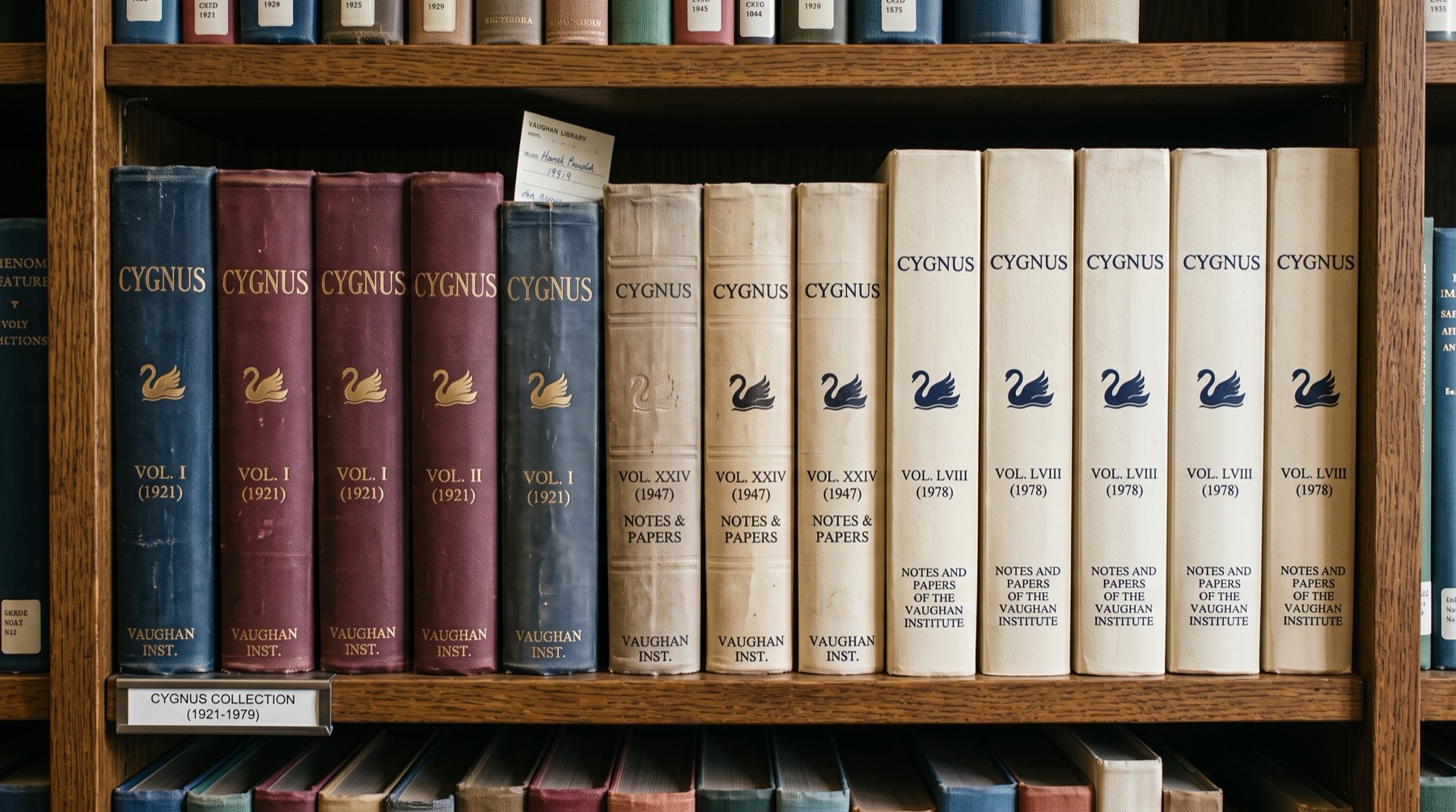
Notes and Papers of the Vaughan Institute. New Series, Number 60 · Summer 2026 · Issued for the Trustees. The first complete number to be digitised; the printed copy may be had from the Librarian while stocks last, which they will. Return to the contents lists.
CONTENTS — Editorial note · Why the Vessel is closed: the Trustees’ minute of 1931 (THE KEEPER) · The religion-names of the Vigil Book: a failed concordance (M. UNDERHILL) · A seventh leaf of the Profession? A census addendum (J. FEATHER) · Correspondence · Notes and Proceedings of the Institute
Contributions are reviewed by the Keeper and one external reader. The Institute regrets that Number 59 appeared in what the wrapper described as Autumn.
Editorial note
This number appears later than intended and shorter than hoped, which readers of long standing will recognise as the journal’s settled form. It contains, however, a paper the Keeper has declined to write for some years, concerning the Trustees’ minute of 1931 and the standing instruction regarding VI.1919.07; the Trustees having now consented to publication of the minute in full, the Keeper’s reasons for delay are exhausted, and the reasons for the instruction may at last be judged by readers rather than guarded by staff. The Institute continues to hold that the plainest account of a thing is the best custody of it. Whether the present paper vindicates the policy, readers will decide; the Keeper’s private view is that plainness, applied to this object, has limits that were reached in 1931 and have not moved since.
Why the Vessel is closed: the Trustees’ minute of 1931 — by THE KEEPER
The standing instruction is well known to readers and to the correspondents who test it yearly: the vessel VI.1919.07 is not to be opened by force, drilled, x-rayed under load, or subjected to any procedure “that would be final.” Visitors suppose the instruction is conservation. Correspondents suppose it is theatre. It is neither; it is obedience — and the Institute has been obeying a document it has never fully understood for ninety-five years, which is long enough that the document should now be printed and the obedience examined.
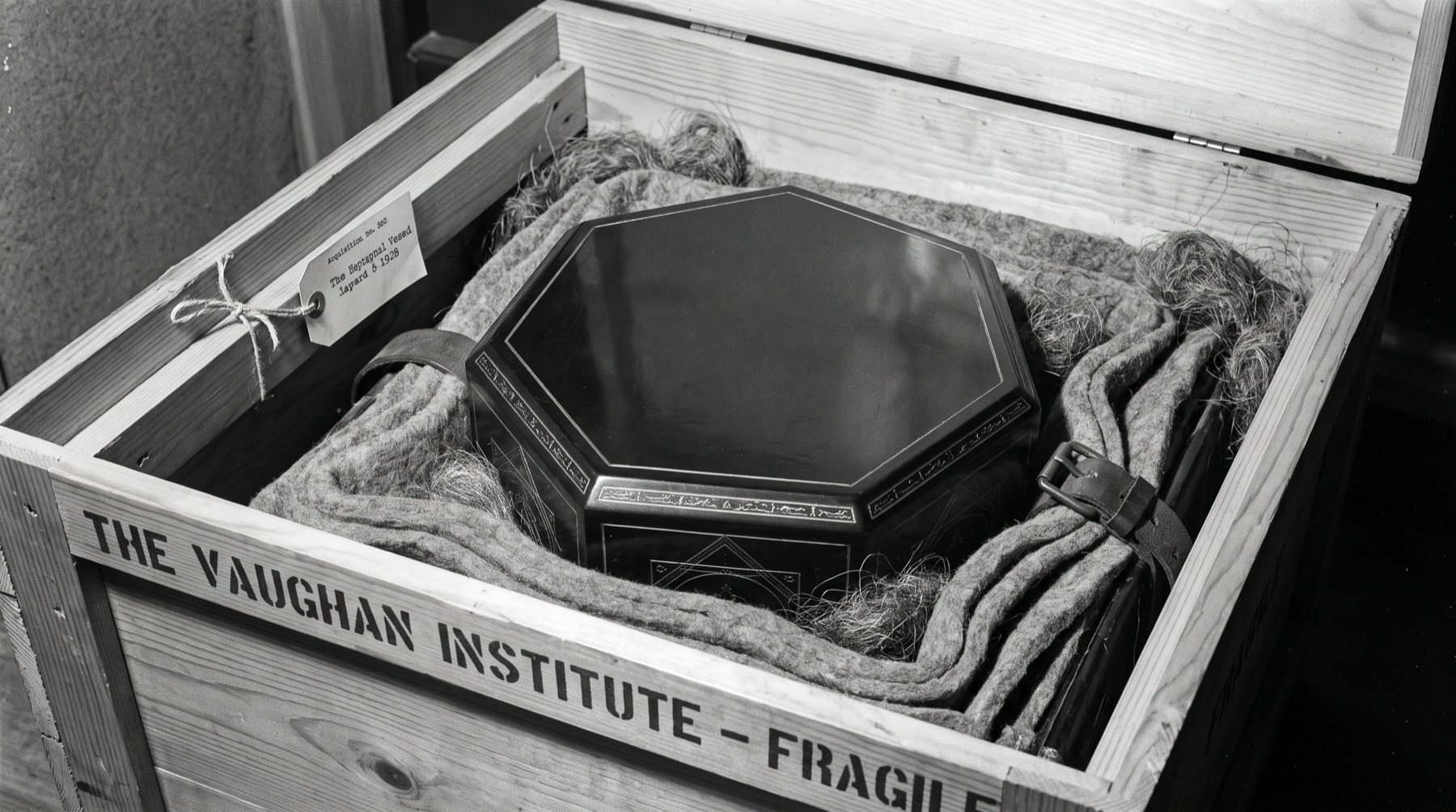
When Naismith opened the sealed archive in March 1931, the uppermost paper was a single folded sheet, in the Warden’s late hand, docketed Concerning the Vessel. The Trustees met on 9 April; the relevant minute is here published in full and without emendation:
“Read, the paper docketed ‘Concerning the Vessel,’ viz.: — ‘The Vessel is not locked. It is closed, as a fist is closed, and like a fist it will open for no instrument that a fist would resist. It answers the hand that asks it in its own manner. Force will gain the contents and lose the object, for the contents are not in it in the way the forcer supposes. We have written nothing else of this and will not.’ — Resolved: that the paper be entered in this minute; that the vessel be preserved closed; that no procedure be permitted upon it that would be final; and that the sense of the words ‘in its own manner’ be recorded as not understood by this Board.”
I draw the reader’s attention to the honesty of the final clause, which successive Boards have declined to amend, and to three features of the Warden’s paper that repay attention.
First, its category. This is not ritual writing. The archive’s ritual papers are ornate, allusive, and — the accounts paper in our Number 47 made the point — almost wholly unconcerned with the physical objects, which they treat as furniture. Concerning the Vessel is plain, imperative, and concerned with nothing else. It is, generically, an instruction for use, of the kind a departing tenant leaves regarding a difficult stove. The Order mythologised everything it touched; here, uniquely, someone wrote a manual.
Second, its claim. “It answers the hand that asks it in its own manner” agrees precisely with the one independent witness we possess, set down seventy years earlier by a diarist who cannot have read it: Considine’s report (14 June 1863) that the Vessel “opens for no hand, only for a habit of the hand.” Two witnesses, separated by seventy years and by temperament — she reluctant, he plain — describe the same mechanism: not a key, not a catch, but a practice. The Institute’s conservators, who have handled the object under the instruction’s constraints, add the only physical observation permitted them: the seven faces are not identical in their freedom, and the object, handled, has what one report calls “preferences.”
Third, its warning, which is the reason the Keeper delayed this paper and the reason the instruction stands. “The contents are not in it in the way the forcer supposes.” The sentence is either the purest specimen of the Order’s mystification in the whole Deposit, or it is exact. The Trustees of 1931 resolved, in effect, that the Institute could not tell the difference, and minuted their incomprehension rather than disguise it. The present Keeper, after years with the object, endorses the resolution and its humility both. We are a custodial body. We hold things whose makers are gone and whose warrants are broken, and where an instruction survives intact, we follow it — not because we believe the makers, but because following is what custody is. The Vessel is closed. It is not locked. The distinction is the Order’s last communication, and the Institute, which has spent a century declining to believe the Order’s account of its past, finds that it has spent the same century obeying the Order’s one account of its future.
Researchers who believe they have understood the mechanism are asked, as the catalogue asks, to notify the Keeper. None yet has. The interactive record remains available, and the reader now knows exactly as much as the Institute does, which was the purpose of this paper, and its discomfort.
The religion-names of the Vigil Book: a failed concordance — by M. UNDERHILL
Every member of the Order signed in a religion-name, and the register preserves some two hundred of them across its hundred and forty-nine years. This paper reports an attempt to construct a concordance between the religion-names and civil identity, and its failure, which proved more instructive than success was likely to be.
The method was the obvious one. The household accounts name tradesmen, landlords, and occasional executors; wills and probate records name the dead; the diarist Considine, our one identified member, provides a fixed point — her hand can be matched to her register signature, “Soror Vigilans.” Around such fixed points a concordance ordinarily crystallises. Here it does not, and the reasons are worth setting out, because they show the Order’s secretiveness was not a manner but a method, applied with a consistency its theology never achieved.
First: the register’s hands and the accounts’ hands do not overlap. Whoever kept the money did not sign the book; whoever signed the book never once, in a century and a half, receipted a bill. In an ordinary society the treasurer’s signature appears everywhere and identifies him in an afternoon. The Order structurally separated its money from its names, which is to say it anticipated exactly the reconstruction here attempted, a hundred years before anyone attempted it.
Second: the religion-names themselves are systematically unrevealing. Victorian esoteric societies chose mottoes that were Latin confessions of aspiration and, frequently, of identity — initials retained, family mottoes adapted; half the Golden Dawn can be identified from its mottoes alone. The Order’s names, by contrast, are a closed vocabulary: they are drawn, all two hundred, from a fixed stock of compounds referring to the Gates, the stations, and the Watch, and the same name recurs across generations as its holder dies and is replaced. They are not mottoes. They are offices. One does not identify a man from the name “Ostiarius” for the same reason one does not identify him from the name “Treasurer”: the name outlives every man who holds it.
Third, and the point on which the concordance finally broke: the excisions. Sixty-one leaves were cut from the register by the compilers, and their placement is not random. I mapped the stubs against the surviving entries, expecting the excisions to cluster around scandal — deaths, departures, the 1889 rebuff. They cluster instead around advancements. The register records receptions fully and dissolutions fully; what it does not record — what someone removed, evenly, across a century — is the moment at which any named member became anything else. The Vigil Book will tell you who entered the house and who left it. Who moved between its rooms, and when, and by what stair, has been cut out with a knife.
The concordance is therefore abandoned, and this paper is its tombstone. I record one observation in closing. A society that hides its members’ names is secretive. A society that hides, specifically and only, its members’ progress has a different concern altogether, and I leave to readers the question of what that concern protects: the members, the progress, or the stair.
A seventh leaf of the Profession? A census addendum — by J. FEATHER
My census of the surviving leaves of The Seven-Fold Profession (Number 44) recorded six: B2–B4 and D1–D3, all in the Institute’s keeping, no other institution or sale record known. In November last a continental dealer’s catalogue offered “a leaf from a Frankfurt tract of 1618, quarto, the seven-fold profession of the gates, browned, margins shaved,” and the Institute, moving with what for the Institute was considerable speed, secured it within the month.
It is not a seventh leaf. It is a nineteenth-century facsimile of our own leaf B3, on paper whose wiremarks are wrong by two centuries, executed with real skill and one error: the facsimilist has “corrected” B3’s inverted terminal s in line 14, which the genuine compositor set upside-down and which every reader of the original knows as one knows a friend’s scar. The correction is the confession.
The interest of the object — and it has been accessioned, as VI.2025.01, the first addition to the collection in a century — is what it implies. Someone in the nineteenth century had access to leaf B3, before the Deposit, for long enough to reproduce it line-perfect; and someone thought the Profession worth forging. The Order forging its own foundation-text would surprise no reader of this journal. But the paper is French, and the register records no continental member, and there the addendum must rest: the census stands at six leaves, one ghost, and a new question, which is the usual rate of exchange in this collection.
Census, revised: six genuine leaves (VI.1919.02); one facsimile of B3 (VI.2025.01); no complete copy recorded.
Correspondence
The Keeper prints such letters as instruct, amuse, or usefully embarrass the Institute, and answers the remainder privately or, where no address is given, not at all.
From Dr. R. S., Cambridge. — Sir: Underhill’s forthcoming concordance paper was described at a seminar here as “an obituary for prosopography.” May the method at least be published, that others may fail differently? — The Keeper replies: it is published above, with the failure attached, which is the Institute’s understanding of full disclosure.
From Mr. T. G., Salford. — Sir: I have solved the cipher signature of your Instrument of Dissolution, which reads, when the characters are numbered against the Hebrew alphabet and reversed, [remainder withheld]. I require only confirmation to publish. — The Keeper replies: the Institute has received, since 1931, one hundred and forty-two solutions of the signature, of which no two agree. Mr. G.’s is filed with the others. Confirmation is not withheld out of discourtesy; it is withheld because the Institute could not confirm a correct solution if it received one, having nothing to check it against — a circumstance the solvers, in ninety-five years, have never once considered.
From Mrs. E. L., Dulwich. — Sir: my late father visited the Institute as a boy in the 1950s and maintained to the end of his life that a member of staff told him the reading room “was quieter on quarter-days, because the books were listening.” Did the Institute ever employ such a person? — The Keeper replies: yes. See the notice of Mr. Naismith in our biographical register. The Institute offers Mrs. L. its assurance that the books do not listen, and its admission that the reading room is, for reasons of the calendar and coincidence, genuinely quieter on quarter-days, when the Keeper prefers to work alone and sees no reason to be ashamed of it.
Notes and Proceedings of the Institute
Conservation. The tablet VI.1919.31 (“the Goat of Mendes”) has undergone consolidation of the gilding at the left crescent and the letters SOLVE, which were lifting; the work, generously supported by the Friends, confirmed that the gilding is water-gilt over a bole whose composition is consistent with London workshop practice of the 1860s–80s, and the object’s dating is accordingly narrowed and its entry revised. The tablet was off display for eleven days. The Institute thanks visitors for their patience and declines to speculate on the origin of the rumour that it was removed for other reasons, which reached the Keeper, by the modern channels, within four hours of the case being opened.
Accessions. VI.2025.01, facsimile leaf (see Feather, above). The first accession since the Deposit; the Trustees have resolved that the numeration VI.2025.– be opened for it rather than extend VI.1919.–, “the Deposit being complete as received, whatever the inventory says.”
Digitisation. The catalogue records of VI.1919.01, .07, .12–18, .19, .22–23, and .31 are now online, several with photography and one with an interactive record. Funds permitting, the diary excerpts follow. Readers noting errors are asked to write; the Keeper reads such letters with gratitude and answers them slowly.
The Friends. The Friends’ annual visit took place in May; the Librarian’s talk, “Thirty Years of Reader-Ticket Refusals,” was received, the minute-book records, “with more sympathy than the refused might imagine.” Subscriptions fund conservation and the digitisation programme. Legacies are received with particular gratitude and, where the testator wishes, discretion.
Obituary. MISS E. P. WRAY, volunteer 1971–2024, died in January, aged ninety-six. She indexed the war-losses list, re-boxed the household accounts twice, and held, unofficially and immovably, the post of institutional memory. Asked once by a television researcher whether the Institute was hiding anything, she gave the answer the staff have used since: “Everything. That is what an archive is.” She is much missed, most of all on quarter-days.
CYGNUS n.s. 60 · Issued for the Trustees of the Vaughan Institute · Printed copy may be had from the Librarian while stocks last, which they will.